Before
- Purchase orders arrive as PDFs and emails from boutiques, reps and designers, and someone retypes every line into the order system.
- Old SKUs, last season's prices, odd case packs and items that are short on stock are caught by eye, if they're caught at all.
- Confirmations, backorder and delay notices are written one by one, often after the buyer has already asked.
After
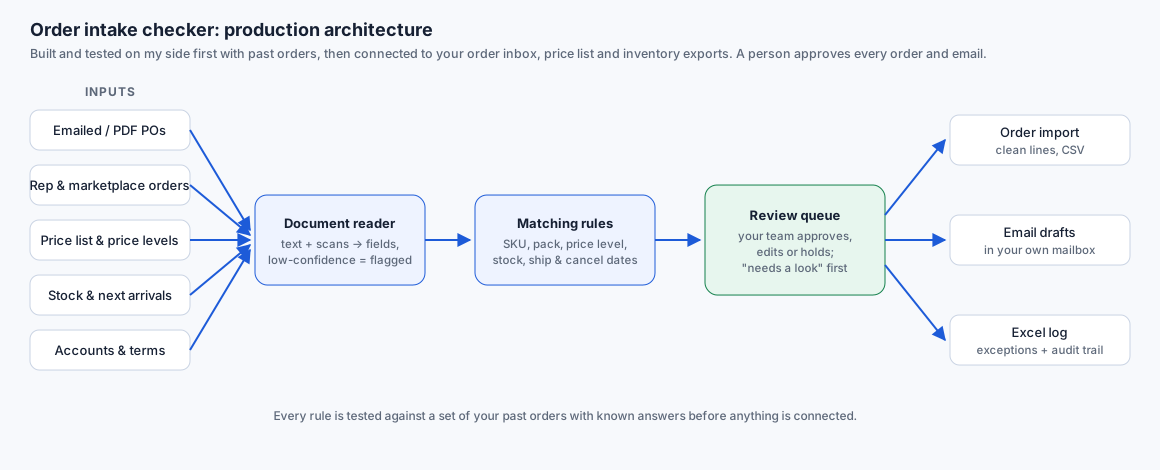
- Each PO is lined up against your price list, stock and the account on file: SKU, pack, price level, terms, ship-to, ship and cancel dates.
- Mismatches are flagged, and anything unclear is marked needs a look. Your team makes every call; nothing is released or sent on its own.
- Clean lines come out as an order import CSV, and a draft confirmation or delay notice lists exactly what needs the buyer's OK.
Purchase order (text as it comes off the PDF or email; pick a sample, edit it, or paste your own)
Sample POs:
This page reads text only. In a pilot, PDF and scanned POs are read first, and any field that can't be read with confidence is shown as "needs a look" instead of being guessed.
Pick a sample PO or paste your own.
Match table
Every row shows what the PO says next to what your files say.Order lines ready for entry
Order import CSVOnly clean lines; columns are mapped to your system's import file in a pilot. A person reviews before import.
Draft reply to the buyer
Draft · not sentTo: Cc rep: Subject:
Edit freely. In a real build it opens as a draft in your own mailbox; nothing goes out on its own.
Under the hood: fields read from each document (JSON)
How the check works
- Read. The PO becomes structured fields: PO number, retailer, buyer, order, ship and cancel dates, ship-to, terms, and every line (SKU, description, quantity, unit price, extension). This page uses a deterministic label parser; a production build adds document reading for PDFs and scans and is held to the same field list, with this parser kept as a test check.
- Match. Each SKU is found in your price list (old SKUs are mapped to their replacements and called out). Quantities must fit the case pack. Unit prices must equal the account's price level. Stock and next arrivals decide what ships now, what splits, and what lands after the cancel or needed-by date; made-to-order items use their lead time.
- Hold, don't guess. Unreadable quantities, unknown items, different terms or ship-to, and a PO total that doesn't add up are held out of the export. A person decides.
- Prepare. Clean lines become order import rows, and the reply to the buyer confirms what's ready and asks only about the specific items that need their OK.
Production architecture